Reflejos de Manuela Román: el Alma de Cartagena en un Lienzo
Original painting of Cartagena de Indias
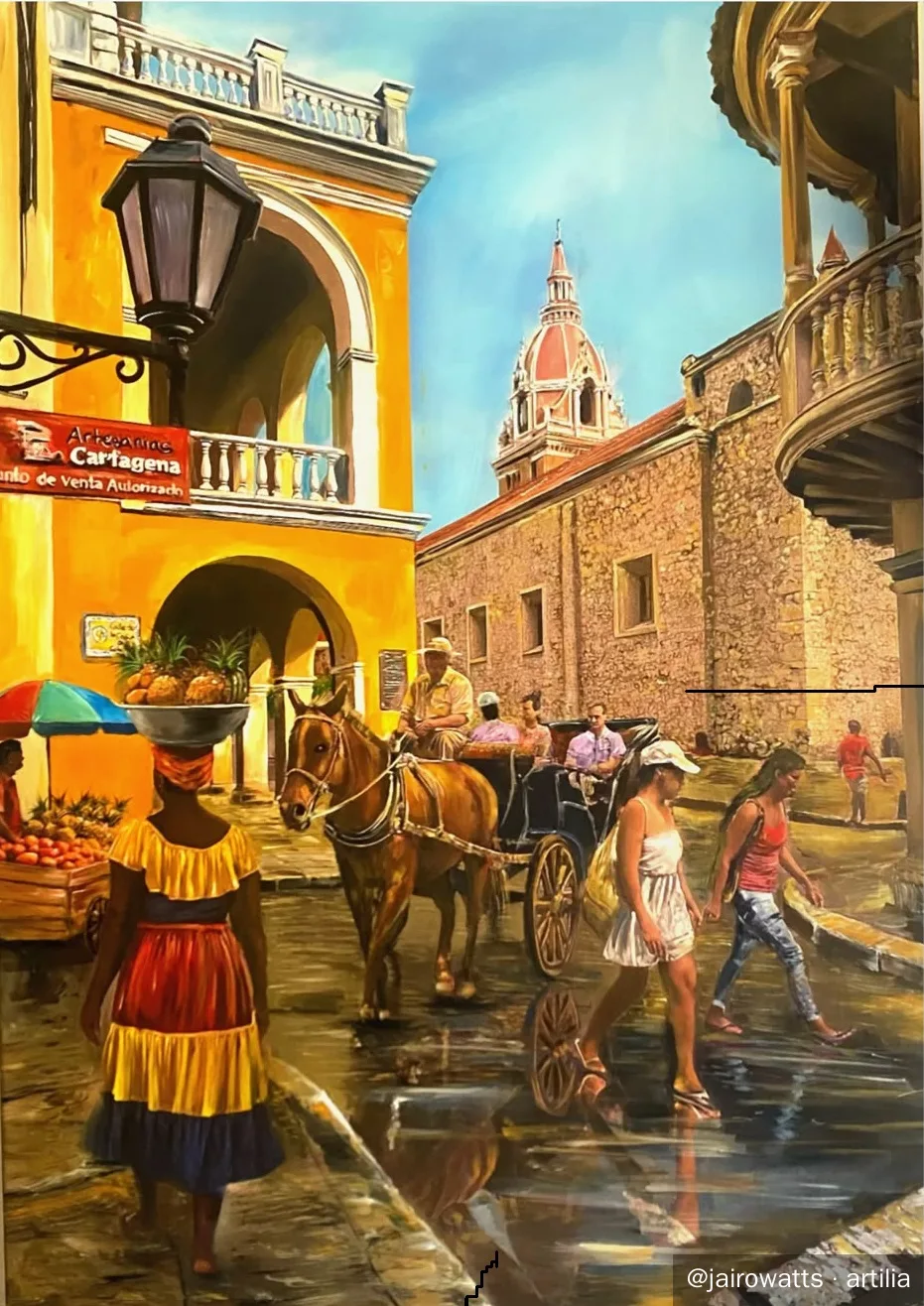
Reflejos de Manuela Román: el Alma de Cartagena en un Lienzo, original painting of Cartagena de Indias. Acrylic on canvas, 100 × 150 cm, by Colombian artist…
Reflections of Manuela Román, Jairo Watts, Colombian art, Calle Manuel Román y Picón, Cartagena rain reflections, palenquera painting, Colombian art Miami, buy Colombian art New York, acrylic on canvas, hyperrealist Cartagena art
Reflections of Manuela Román: The Soul of Cartagena on Canvas
Reflections of Manuela Román: The Soul of Cartagena on Canvas transports the viewer to one of the most evocative streets within Cartagena de Indias’ Historic Center, where colonial architecture, republican history, and everyday life converge beneath the golden light of the Caribbean. Known today as Manuel Román y Picón Street, formerly Calle del Lázaro, this historic thoroughfare honors one of the families that profoundly shaped Cartagena’s economic, scientific, and cultural development. The Román family, led by Spanish pharmacist Manuel Román, founder of the renowned Botica Román in 1835, left an enduring legacy through medicine, industry, philanthropy, and entrepreneurship.
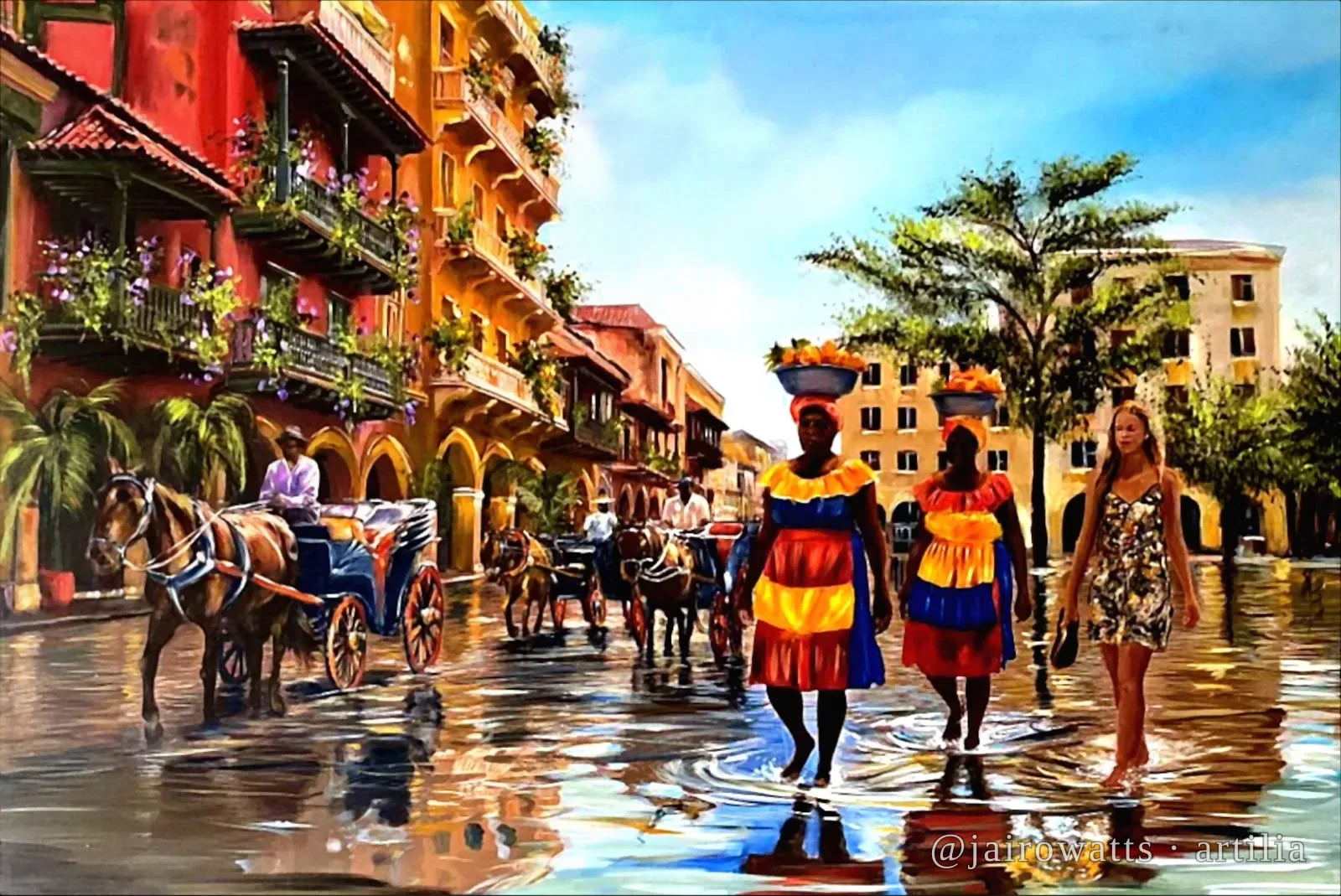
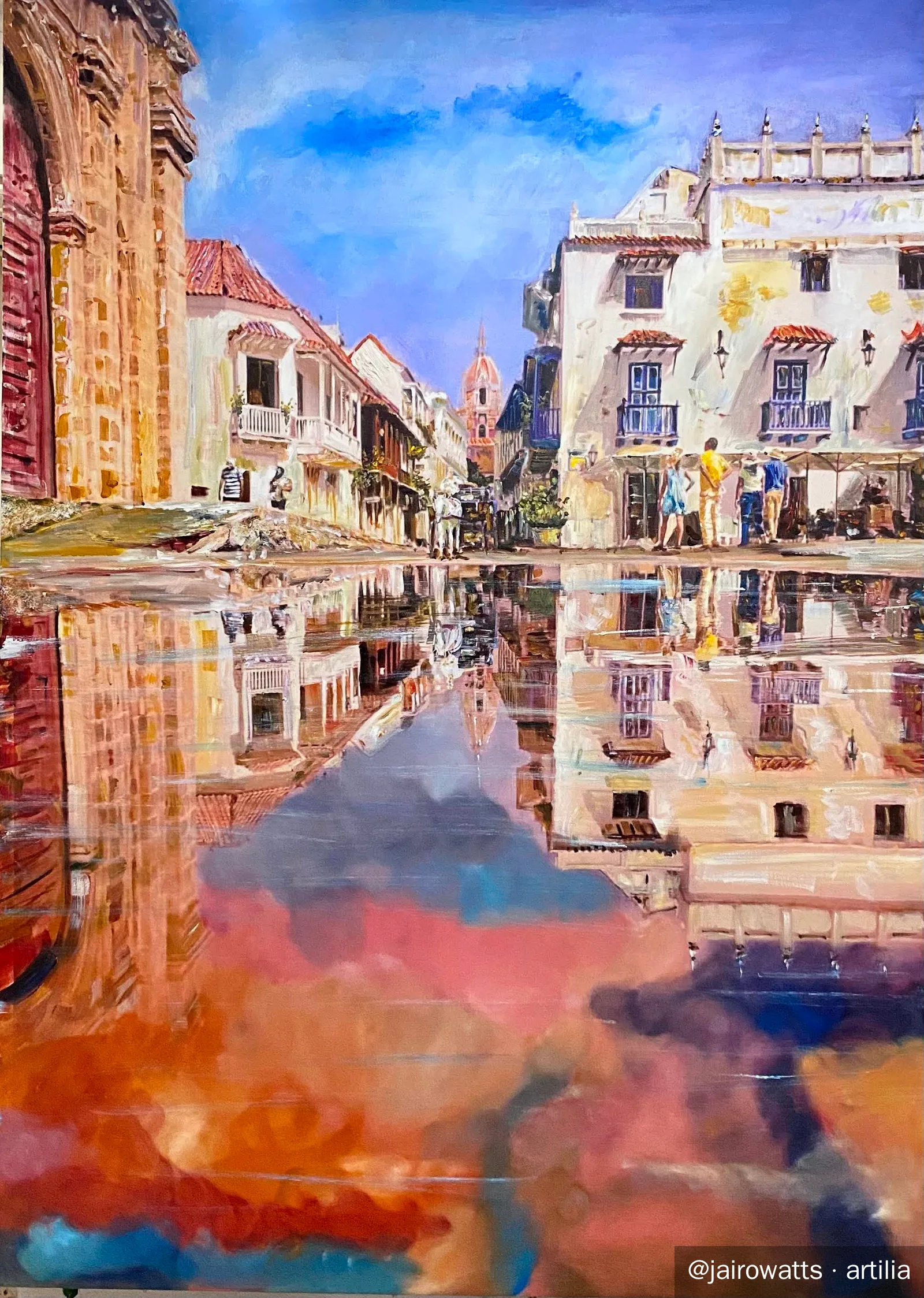
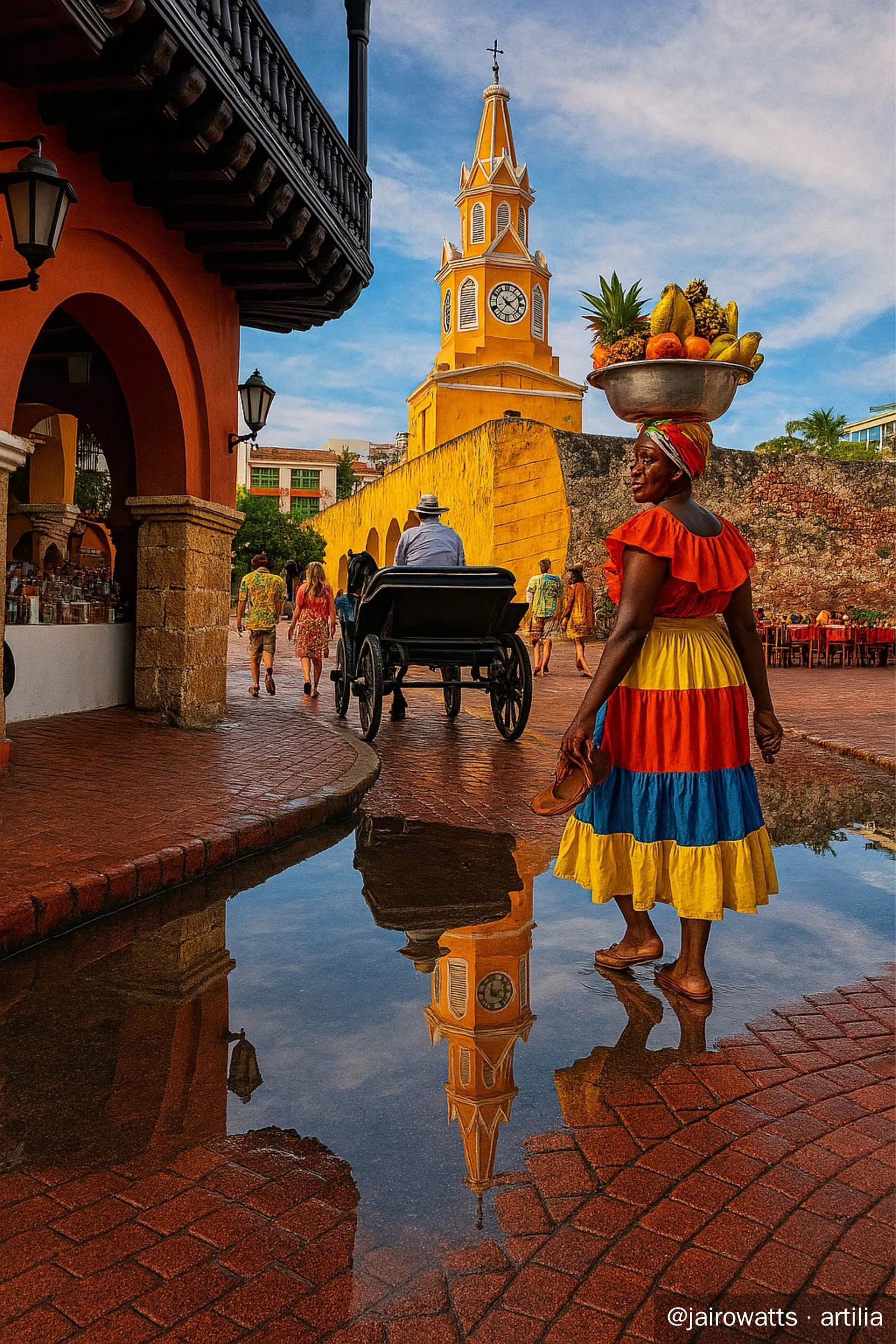
Jairo Watts captures the magical moment after rainfall, when the cobblestones become liquid mirrors reflecting colonial balconies and centuries-old façades. A horse-drawn carriage moves slowly through the scene, symbolizing suspended time, while the dome of Saint Catherine of Alexandria Cathedral rises in the distance as the city’s spiritual guardian. The presence of the palenquera introduces the African heritage that helped shape Cartagena’s identity, creating a bridge between popular memory and monumental history.
The reflections are more than water; they are metaphors for a city gazing upon its own past. Golden yellow symbolizes prosperity, identity, and Caribbean sunlight; deep blue recalls the sea that transformed Cartagena into one of the most important ports of the Americas; earthy tones evoke the endurance of tradition across centuries. Through extraordinary hyperrealist detail and luminous sensitivity, Watts transforms a historic street into a contemplative space where history, architecture, and daily life exist in harmonious dialogue.
The street opens vertically, pushed upward by a blazing yellow facade that fills much of the canvas. The acrylic builds the scene with an almost photographic sharpness: the blue-painted balusters of the colonial balcony, the iron lantern cutting across the sky, the ochre stone of the neighboring wall and, in the background, the reddish dome of the Cathedral of Santa Catalina de Alejandría rising between the volumes. In the foreground a palenquera walks forward with her tray of pineapples balanced on her head, dressed in red and yellow; beside her, two young women cross a stretch of street that is still wet, while a horse-drawn carriage with its passengers occupies the center. The flooded cobblestones return the reflection of the carriage and the figures, and that mirror of water is what organizes the lower half of the composition.
Watts works here from mimesis, but uses it as a pretext rather than an end. The interest lies not only in reproducing a recognizable corner of the Historic Center, but in the moment just after the rain, when the ground doubles the city and makes it, for a while, twofold. That reflection introduces a second scene, inverted and trembling, that coexists with the first without fully belonging to it. The real street and its image on the water share the same pictorial plane, and the viewer faces two versions of the same place: the solid one, made of stone and centuries, and the liquid one, which will dissolve as soon as the sun finishes drying the puddles.
The piece is born from a concrete material, Caribbean light on wet surfaces, and draws its temporal tension from it. The horse-drawn carriage and the palenquera belong to a long memory; the tourists in summer dresses and sandals belong to the present walking on the same stone. There is no hierarchy between them: they coexist in the same frame like layers of a city that has never stopped being lived in. The dominant yellow of the facade, warm to the point of saturation, sustains that feeling of a suspended midday, and the crafts sign is a reminder that this corridor is also a place of commerce and of outside eyes.
Cartagena de Indias carries a history of colonial architecture, republican life and an African heritage that the palenquera brings to the foreground without any need for explanation. Her figure, seen from behind, works as a silent guide into the scene: she is the one who leads us into the street.
It remains for the viewer to decide which of the two cities weighs more: the one standing on the cobblestones, or the one floating, distorted, on the water that will soon disappear.
Details
- Technique
- Acrylic on canvas
- Size
- 100 × 150 cm
- Year
- 2026
- Collection
- Reflejos
- Place
- Cartagena de Indias
- Status
- Available
- Price
- USD $1,071
An original painting by Jairo Watts, Colombian artist of the Caribbean, signed and delivered with a certificate of authenticity registered on the blockchain. Contact the artist to buy it or to arrange shipping to your door.
International shipping with DHL Express to any country: canvas rolled in a tube, USD 150 on average, paid by the buyer and confirmed with you before dispatch. Stretched on its frame, shipping costs more and is quoted separately.