Sinfonía de Mariposas
Original painting by Jairo Watts
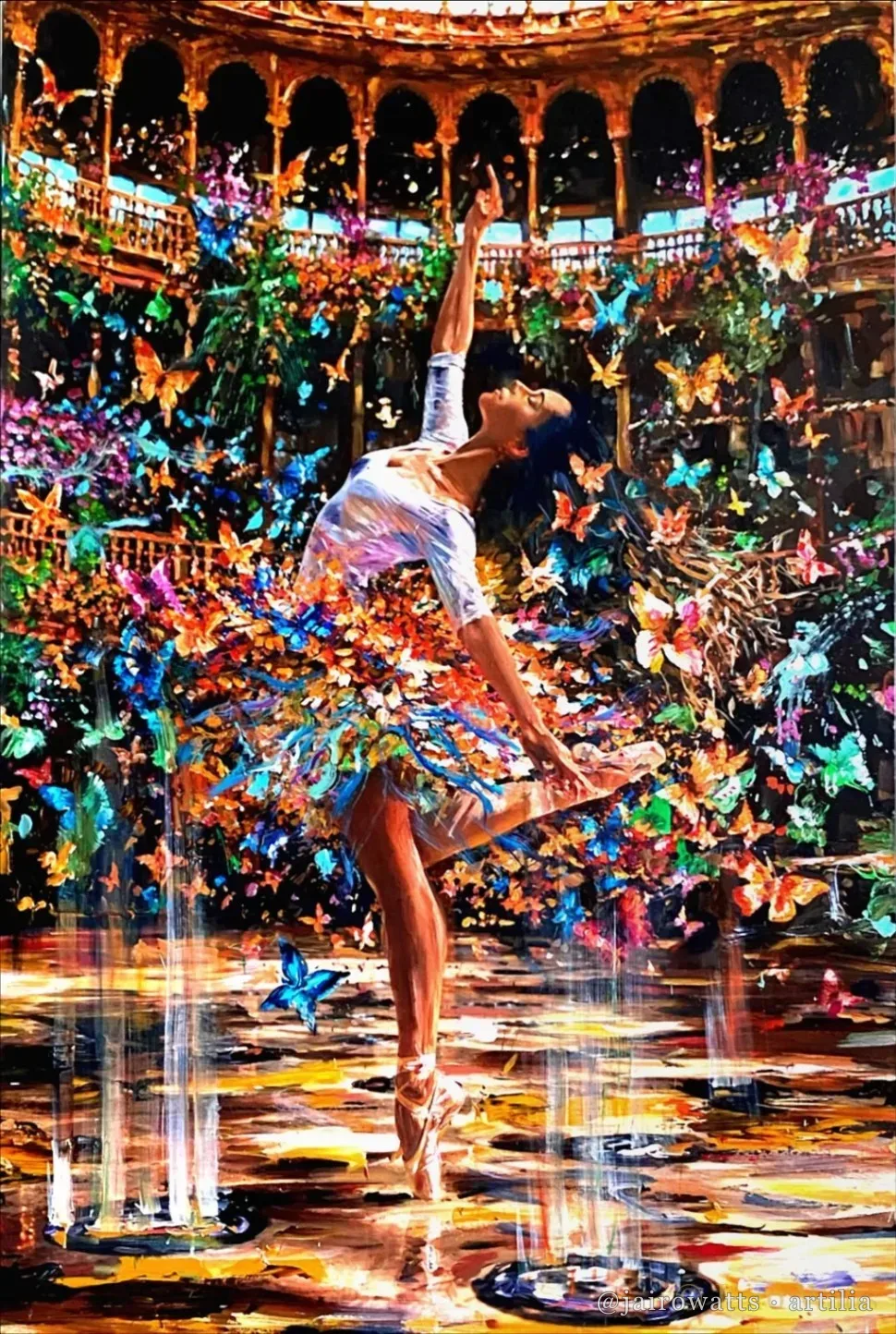
Sinfonía de Mariposas, original painting. Acrylic on canvas, 100 × 150 cm, by Colombian artist Jairo Watts. Available. A ballerina arches backward at the…
A ballerina arches backward at the center of La Serrezuela, Cartagena's old circular bullring turned cultural center, her skirt made of a swarm of butterflies. An original acrylic on canvas from Jairo Watts's Ballet collection.
Where History Dances Again
Against a backdrop of golden arches and balconies overflowing with painted flowers, a ballerina bends into an arabesque as though the canvas itself were breathing alongside her. Jairo Watts builds his acrylics in thick, textured layers, letting color run in literal vertical drips down the surface of the painting — threads of pigment that fall like time itself melting over old wooden floorboards. The palette burns in controlled fire: ochres, coppers and deep greens erupting into swarms of butterflies, while the dancer's body, painted in near-translucent white, becomes the single point of stillness inside all that motion. It is a work that breathes theatre, memory, and rebirth in equal measure.
The setting is no invention. It is the pictorial echo of a place Cartagena has watched fall and rise three times over. In 1893, atop a hill in the San Diego district — inside the walls that engineer Cristóbal de Roda extended to shelter the fortified city — the first bullring rose, taking its name from that very hill: La Serrezuela. The Thousand Days' War claimed the original structure, but brothers Carlos and Fernando Vélez Daníes, local entrepreneurs of unshakable vision, sent cabinetmaker Marcial Calvo to Maracay, Venezuela, to study the Real Maestranza bullring before raising a second version in 1908. It reopened on June 18, 1930, held up by columns of Canadian oak, and for over four decades it became the city's taurine, theatrical, and musical heart: films were screened there under the name Circo Teatro, the Caribbean Music Festival resonated within its walls, and one December afternoon in 1966 a Spanish parachutist named Luis Ríos, "El Pinturero," staged a fall that painter Enrique Grau would later immortalize in oil.
The last bullfight was held on February 5, 1973. Silence followed, then abandonment, then a National Monument declaration in 1995 that could not halt the decay. For years the timber quietly surrendered to Caribbean sun and salt, as if memory itself were waiting for someone willing to listen again. Between 2015 and 2019, an ambitious architectural restitution — guided by respect for heritage and the work of restoration experts familiar with the Old City — returned to La Serrezuela its central wooden ring, today wrapped in a vibrant, internationally awarded cultural, gastronomic, and commercial center.
In this painting, the dancer occupies the very ring where bulls once thundered and crowds once cheered. The butterflies — that winged multitude covering everything — become the metaphor for a city that does not erase its past but transforms it into another form of life. Cartagena de Indias has learned, through centuries of mixture, salt air, and resilience, that memory is not something to be archived: it is something to be danced. And in every drop of acrylic sliding toward the floor of this canvas, something of that Caribbean light — the same light that watched bullrings become stages for culture — rises once more to dance.
Symphony of Butterflies at La Serrezuela
A ballerina on pointe arches backward at the exact center of a circular theater, her right arm stretched upward as if reaching for something just outside the frame. Around her, the air itself seems to have turned into matter: hundreds of colorful butterflies, blue, orange and fuchsia, blend with foliage and flowers until it is no longer clear where the dancer's dress ends and the garden around her begins. Her skirt, instead of tulle, is made of that same swarm of wings. Behind her, the golden arches and curved balustrades of La Serrezuela, Cartagena's old bullring now reborn as a cultural and shopping center, frame the scene like a classical proscenium, and the floor shines with the reflection of water and light running down in vertical streams, as if the theater's own floor had melted into a cascade.
What first organizes the eye here is precisely that fusion: body, dress and setting stop being three separate things and become a single continuous surface of color and movement. There is no hard boundary between the dancer's skin and the butterflies that clothe her, nor between those butterflies and the ones floating freely in the air of the theater. It is an image built on the logic of metamorphosis: everything in the painting seems to be in the process of becoming something else, frozen exactly halfway.
That backward arch, face turned to the sky and arm extended, is less about depicting a technical ballet step than about capturing the moment of greatest tension and surrender in the body, the moment when the dancer stops controlling the movement and gives herself over to it. That is where the painting comes closest to expression rather than mere mimesis: it does not try to faithfully copy a body in motion, but to translate visually the vertigo and freedom of that instant, which is why the world around the dancer dissolves into pure color instead of staying true to the real architecture of the place.
The choice of La Serrezuela as a setting is not incidental. A building that was once a bullring, a space historically tied to spectacle, blood and the control of the animal body, becomes here a butterfly garden where the human body, by contrast, is set free and blossoms. That contrast between what the place was and what the painting proposes it can be today gives the work a second layer of meaning beyond the decorative: the metamorphosis belongs not only to the dancer's dress, but to the very space that holds her.
In the end, the work can be read as an open invitation rather than a closed allegory. The butterfly carries the obvious symbolism of transformation and the ephemeral, but the painting does not exhaust it in a single message. Each viewer can complete, from their own experience, what exactly this dancer is leaving behind and what she is reaching toward with that arm stretched up to the golden ceiling of Cartagena's old bullring.
Details
- Technique
- Acrylic on canvas
- Size
- 100 × 150 cm
- Year
- 2026
- Collection
- Ballet
- Status
- Available
- Price
- USD $1,675
An original painting by Jairo Watts, Colombian artist of the Caribbean, signed and delivered with a certificate of authenticity registered on the blockchain. Contact the artist to buy it or to arrange shipping to your door.
International shipping with DHL Express to any country: canvas rolled in a tube, USD 150 on average, paid by the buyer and confirmed with you before dispatch. Stretched on its frame, shipping costs more and is quoted separately.