Infancia en los Portales de la Marquesa
Original painting of Santa Cruz de Mompox
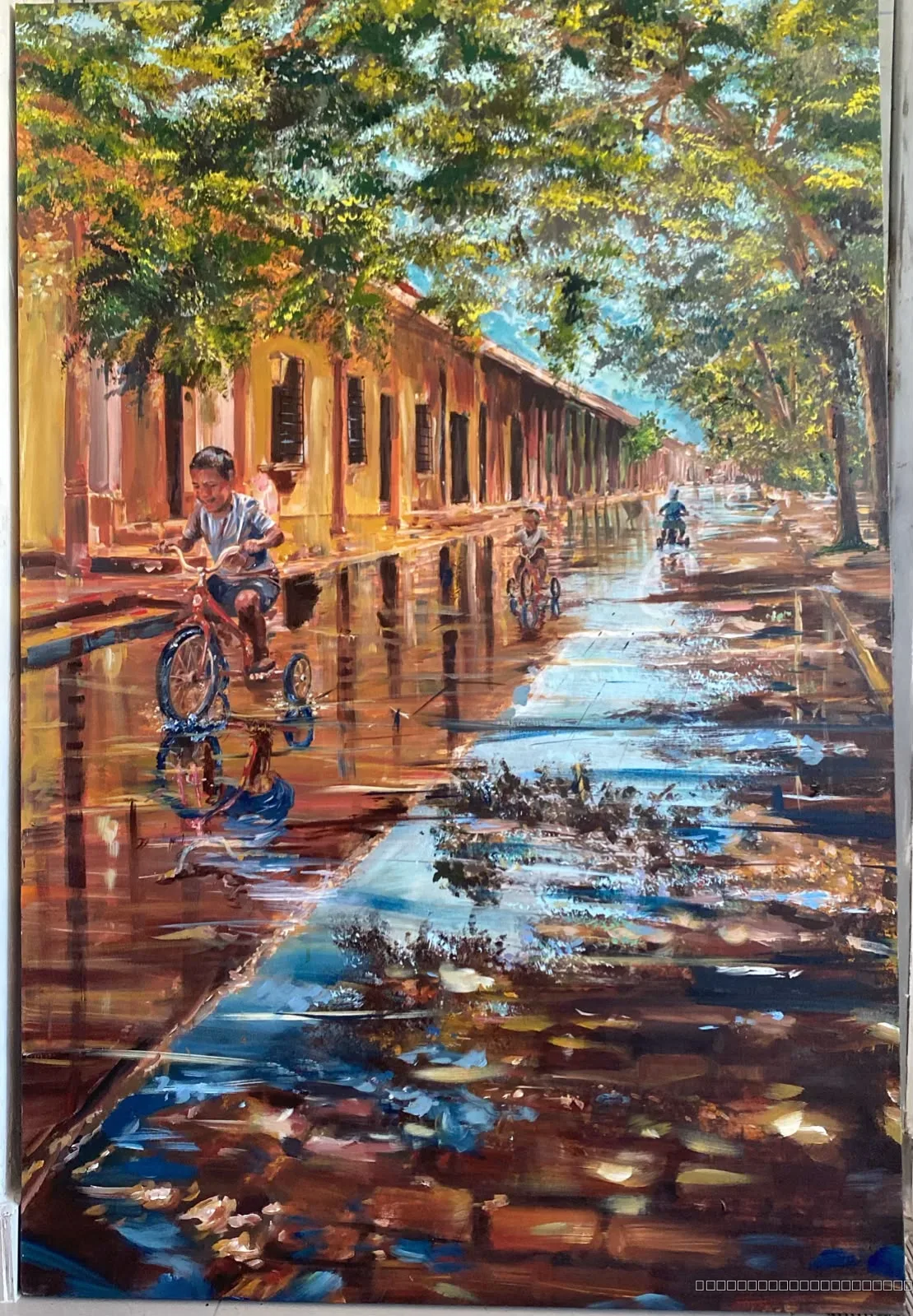
Infancia en los Portales de la Marquesa, original painting of Santa Cruz de Mompox. Acrylic on canvas, 140 × 90 cm, by Colombian artist Jairo Watts. Available.
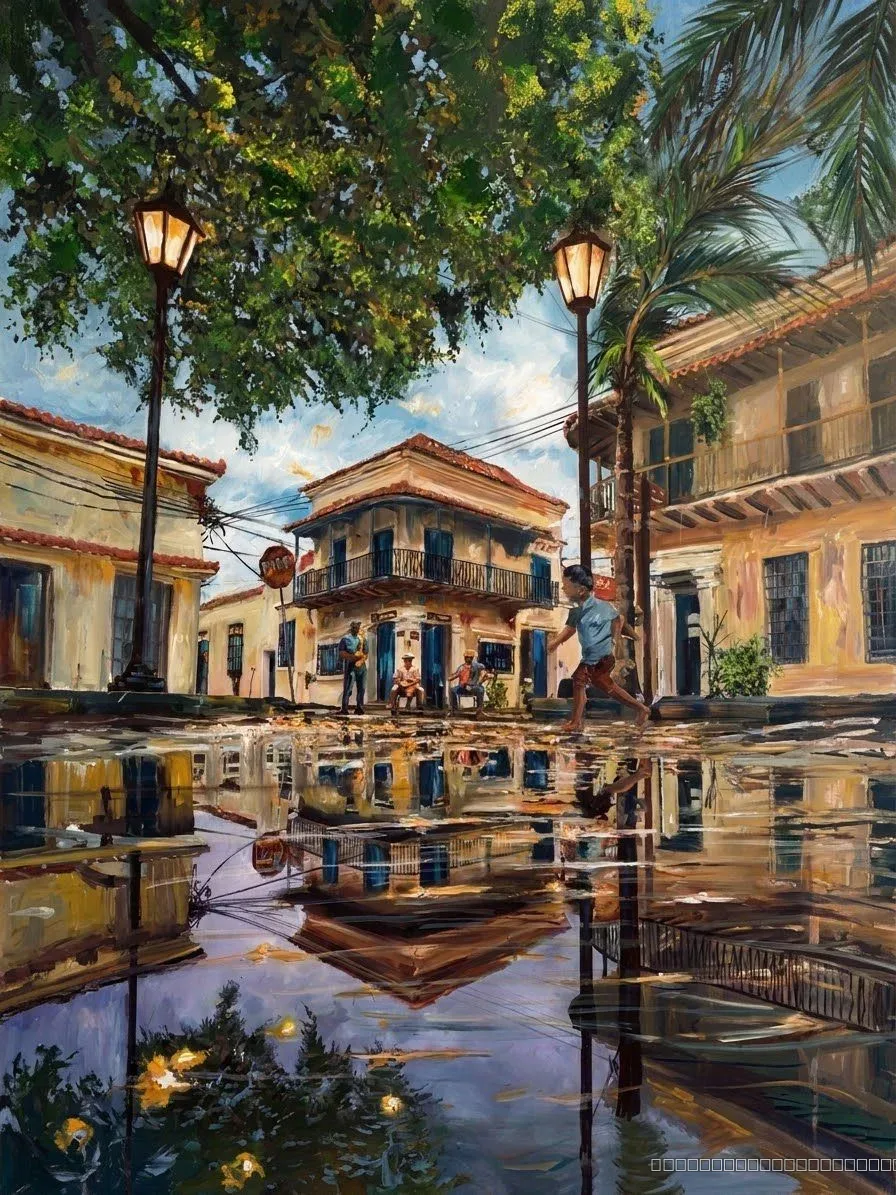
Just after the rain on the Albarrada of Mompox, a boy rides his red tricycle through the puddles under the colonial arcades of the Portales de la Marquesa. An original acrylic on canvas about childhood, the Magdalena River and memory.
The rain stopped only a few minutes ago. The air of Mompox still smells of wet earth and of warm stone cooling down. It is that uncertain hour of the afternoon when the freshly washed sky peeks shyly between the crowns of the centuries-old trees that have shaded this street for generations.
This is not just any street. It is the Albarrada, the oldest living memory of a town that was born facing the Magdalena River. Almost five centuries ago, when the floods threatened to swallow the houses, the people of Mompox built stone barriers here, the albarradas, to hold back the water. Over time, the name of the dike became the name of the street, and the street became the commercial heart of an entire region: warehouses, depots, boats loaded with goods traveling back and forth between Cartagena and the interior of the country, in the days when the river was the only possible road.
Of that colonial splendor, what remains are the arcades seen in the painting: the Portales de la Marquesa, with their columns and arches that once gave shade to merchants and travelers, and that still give shade today, though to a different kind of life.
Because that is what has remained, after the river lost its importance and the boats stopped docking: the simple life of the town. And there it is, in the foreground: a boy on a red tricycle, laughing, his feet splashing in the puddle left by the downpour. He does not know, nor does he care, that he is pedaling over stones that saw marquises, merchants and enslaved people pass by, wars of independence and centuries of oblivion. For him, the wet paving is simply a perfect mirror for tricks on his bike, and the shade of the portales is just the natural roof of his afternoon of play.
Further back, another child follows on his own tricycle, and beyond that, someone else walks away toward the vanishing point of the street, toward that bluish light reflected in the still water as if the sky had spilled onto the stones.
The painting captures, almost without meaning to, the very essence of Mompox: a town that grew great through its river and its trade, that was forgotten for decades as the hidden pearl of the Caribbean, and that survives today not through its monuments, but through these small everyday gestures: a child, a bicycle, a puddle, a laugh, under the same shade that has watched the centuries go by.
The work portrays the Calle de la Albarrada, in the historic center of Mompox, specifically the stretch known as the Portales de la Marquesa, right after a tropical downpour. The artist chooses this moment, with the pavement still wet and the puddles acting as improvised mirrors, to build a bridge between two times that coexist in Mompox: colonial memory and the everyday life of the present.
The Albarrada is not just any street. Its name comes from the stone dikes the people of Mompox built to hold back the floods of the Magdalena River, at a time when this street was the commercial axis of a strategic river port between Cartagena and the interior of the country. From that splendor the arcades, the ochre facades and the urban layout remain, and the work reconstructs them with atmospheric precision.
Yet the real protagonist is neither the architecture nor the history, but the figure of a boy crossing the frame on a tricycle, completely unaware of the symbolic weight of the stones beneath him. His spontaneous gesture, reflected sharply in the still water, introduces a gentle tension between monumentality and the everyday: a World Heritage town turned, for a child, into a simple playground.
The painting gives the reflection a central role: the sky, the trees and the facades are doubled on the wet pavement, dissolving the boundary between what is built and its mirror image. This doubling works as a metaphor for Mompox itself: a town that exists as much in its present reality as in the memory, sometimes idealized, sometimes forgotten, of its colonial past.
More than an urban landscape, the work offers a reflection on permanence: how life follows its light and innocent course on the foundations of a much denser history, and how childhood, with its natural indifference to the weight of time, ends up being the most honest way of inhabiting a place so full of history.
Details
- Technique
- Acrylic on canvas
- Size
- 140 × 90 cm
- Year
- 2026
- Collection
- Reflejos
- Place
- Santa Cruz de Mompox
- Status
- Available
- Price
- USD $2,037
An original painting by Jairo Watts, Colombian artist of the Caribbean, signed and delivered with a certificate of authenticity registered on the blockchain. Contact the artist to buy it or to arrange shipping to your door.
International shipping with DHL Express to any country: canvas rolled in a tube, USD 150 on average, paid by the buyer and confirmed with you before dispatch. Stretched on its frame, shipping costs more and is quoted separately.